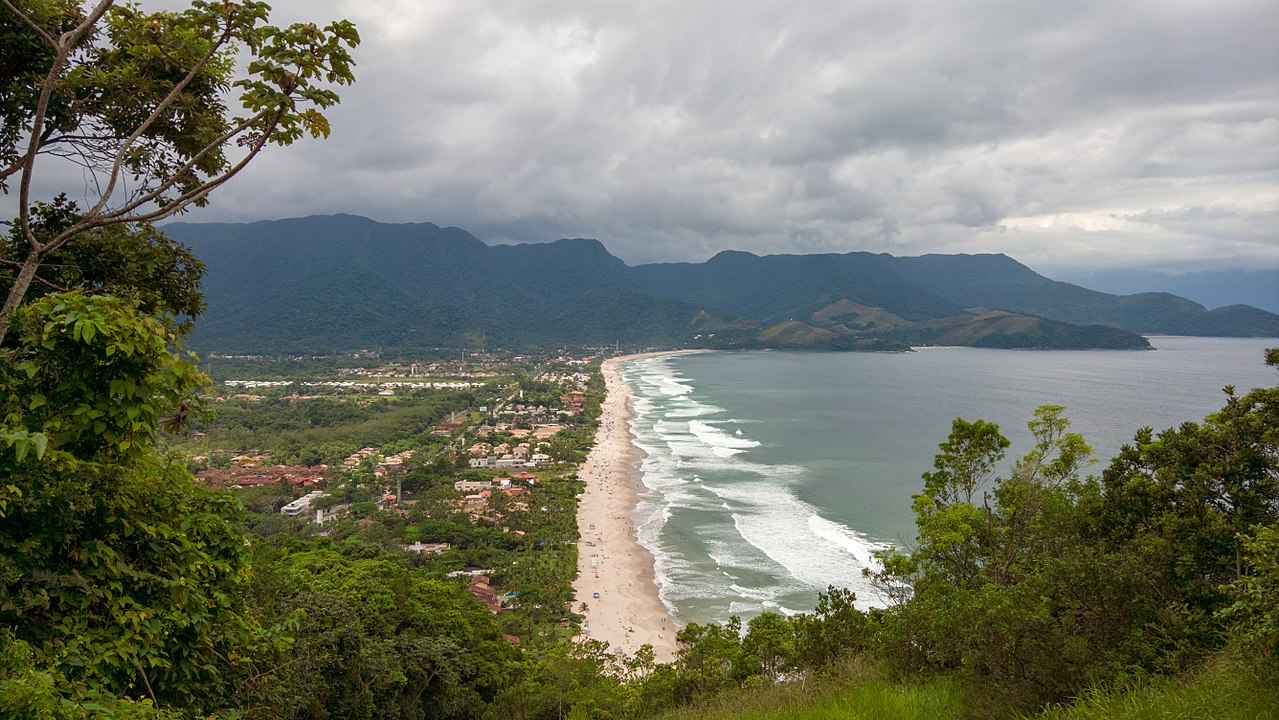
The world tour heads to the north coast of São Paulo. The waiting period opens today, September 26, and runs to October 3, 2026, as Praia de Maresias in São Sebastião hosts the Banco do Brasil São Sebastião Pro, a stop on the World Surf League's Challenger Series. It is the first time São Paulo state hosts an event in the division that feeds the sport's elite tour.
And this is no ordinary beach. Maresias is where Gabriel Medina learned to surf, where the Pupo family lives and trains, and where Brazilian pro surfing has written many chapters over the last three decades. The event lands a week after Miguel Pupo, who grew up on this beach, won at Lower Trestles, and just as the race for 2027 CT spots enters its decisive stretch.
Quick facts: BB São Sebastião Pro 2026
Where: Praia de Maresias, São Sebastião, Brazil
When: waiting period from September 26 to October 3, 2026
Who: 80 men and 48 women from around the world
What is at stake: Challenger Series ranking points. The top 10 men and top 6 women qualify for the 2027 CT
How to watch: live and free on the WSL website and app
On the sand: an opening concert, yoga, functional training, and free sports clinics through the week
The event is one of five stops. After Maresias, the tour moves to Ericeira, Portugal, from October 6 to 12, and it ends in Newcastle, Australia, in March 2027.
Maresias, Gabriel Medina's home break
No name is as closely tied to Maresias as Gabriel Medina's. He was born in São Sebastião on December 22, 1993, and grew up in Maresias. It was on this beach that his stepfather, Charles Saldanha, taught him to surf and built the structure that would take him to the top of the world.
The result became Brazilian sporting history:
2014: the first Brazilian surfing world champion, at age 20
2018: second world title
2021: third world title
2024: bronze medal at the Paris Olympics, surfed at Teahupo'o, with the highest single-wave score of the event (9.9). The photo of him "floating" in midair after that wave went around the world.
In 2017, Medina opened the Instituto Gabriel Medina facing the sea in Maresias, on the same spot where he started surfing. The institute trains athletes aged 10 to 17, with technical and physical coaching, psychological and medical support, English and computer classes, and travel support. His sister, Sophia Medina, also came out of Maresias onto the pro circuit.
In 2026, Medina is on the CT, and he fell in his opening heat at Trestles to another Brazilian, Mateus Herdy, who now competes on the Challenger Series in Maresias.
The Pupo family: from Maresias to the elite
If Medina is the most famous name from Maresias, the Pupos are the beach's most traditional surf family. Their father, Wagner Pupo, spent 16 years in the top division of the Brazilian circuit and ran a surf school on the north coast, where his sons grew up.
Miguel Pupo was born in Itanhaém but raised in Maresias. At 34, he is in the best form of his career: he won at Bells Beach and Trestles in 2026 and sits 4th in the world, in the title race.
Samuel Pupo, known as Samuca, was born in Maresias in 2000. He debuted on the CT in 2022, finished 10th, and was named Rookie of the Year.
Miguel also knows what it feels like to win at home: he took the QS event in Maresias in 2015.
Maresias has hosted the world before
The Challenger Series is new to São Paulo, but Maresias is far from a newcomer. The beach has hosted many qualifying events over the decades, and the list of winners in São Sebastião includes names who later reached the elite:
| Year | Winner | Event |
|---|---|---|
| 2018 | Yago Dora (SC) | Red Nose São Sebastião Pro |
| 2017 | Deivid Silva (SP) | Hang Loose São Sebastião Pro |
| 2015 | Miguel Pupo (SP) | Oi HD São Paulo Open of Surfing |
| 2014 | Filipe Toledo (SP) | O'Neill SP Prime |
| 2010 | Caetano Vargas (SC) | SuperSurf International |
| 2005 | Pedro Henrique (RJ) | Reef Classic |
| 2000 | Christiano Spirro (BA) | Hang Loose Pro Contest |
| 1999 | Peterson Rosa (PR) | Hang Loose Pro Contest |
| 1993 | Renan Rocha (SP) | Sea Club Final Heat |
Look at the names. Filipe Toledo became a two-time world champion, Yago Dora is in the 2026 title race, and Deivid Silva is back in Maresias, now fighting for a return to the CT.
The big names in the water
The field mixes surfers who are one step from the CT with names who have already surfed on the elite tour and want back in.
Men: a points race at the top
Brazil's Weslley Dantas arrives in Maresias as the rankings leader with 15,700 points, only 295 ahead of Hawaii's Jackson Bunch (15,405). Right behind them are two heavy American names: Jake Marshall (14,745) and Cole Houshmand (13,320), who just won the Fiji Pro at Cloudbreak on the CT. Brazil's Ryan Kainalo (10,995) rounds out the top 5.
The home crowd has plenty to cheer for:
Weslley Dantas, the leader, can extend his lead at home.
Ian Gouveia, 6th, with 10,105 points.
Deivid Silva, 8th, with 9,025 points. He won in Maresias in 2017 and knows these sandbars better than most.
Mateus Herdy, 11th, with 8,065 points. He arrives on a high after he knocked out Gabriel Medina in his opening heat at Trestles.
Gabriel Klaussner, 13th, with 7,755 points.
There is room for the locals too. At the city's trials, Rodrigo Saldanha from Maresias and Mayara Zampiery from Cambury earned the two local wildcard spots.
Women: Sierra Kerr out in front
Australia's Sierra Kerr leads comfortably with 20,745 points. Behind her are Portugal's Teresa Bonvalot (13,590), Eden Walla (13,150), Francisca Veselko (12,545), and Ariane Ochoa (11,465). With only six CT spots on offer, every result counts.
For Brazil, Laura Raupp sits 14th with 6,985 points and needs a big result at home to close in on the qualification zone.
The waves at Maresias
Maresias is a sandy beach break about 4 km long, known for its consistency, and for powerful, hollow waves when a south to southeast swell lines up with offshore wind. The organizers expect waves between 0.6 and 1.3 meters during the waiting period.
At a beach break, the sandbars shift from one day to the next. That makes reading the ocean as important as a surfer's range of maneuvers. Swell direction, period, and the timing of the tide decide where the best bank is in each heat. Whoever finds the peak first gets the edge.
A surf guide to São Sebastião
São Sebastião has about 100 km of coastline, and most of the waves are on the south coast, along the Rio-Santos highway (BR-101). If you are going to watch the contest, it pays to know the nearby breaks, which are the usual backup when Maresias is crowded or closing out:
Maresias: about 27 km from the town center. The city's most famous break, for intermediate to advanced surfers on swell days.
Praia Brava: reached by a trail from Boiçucanga. More exposed to swell and far less crowded.
Boiçucanga: about 36 km from the center. The best facilities on the south coast and gentler waves, a good option for beginners.
Camburi: about 40 km from the center. A traditional local surf spot, and home to Mayara Zampiery, the event's local wildcard.
Juquehy: about 51 km from the center. A wide, more sheltered beach with smaller waves most days.
The best season for waves on the north coast runs from autumn to early spring, when cold fronts push south and southeast swells onto the coast. The Challenger Series window, at the end of September, falls right in that period.
Meanwhile on the CT: Erin Brooks makes history
Maresias comes a week after the CT regular season ended at the Lexus Trestles Pro in California.
Erin Brooks (CAN) beat Gabriela Bryan in the final, 13.00 to 11.90, for her third straight CT win, after Teahupo'o and Cloudbreak. Only Stephanie Gilmore (2008) and Carissa Moore (2014/15) had done that before. At 19, the Canadian climbed to World No. 5.
Miguel Pupo (BRA) edged Kanoa Igarashi, 14.77 to 14.40, for his second win of 2026 after Bells Beach. It was his first win at Trestles, and it lifted him to World No. 4, firmly in the title hunt.
Gabriela Bryan (HAW) took back the yellow leader's jersey.
Filipe Toledo lost to Liam O'Brien, a result that ended the two-time world champion's bid to save his season.
What comes next
With the Surf Abu Dhabi Pro cancelled, the CT finishes with 12 events. The next stops:
Challenger Series, Maresias: September 26 to October 3
Challenger Series, Ericeira: October 6 to 12
CT, MEO Rip Curl Pro Portugal (Peniche): October 16 to 25
CT, Philippines Pro (Siargao): October 31 to November 10
CT, Lexus Pipe Masters (Hawaii): December 8 to 20
There is no WSL Finals in 2026. The world title comes down to points: each surfer's best nine results across all 12 events. Pipeline closes the season worth 15,000 points, 50% more than a standard event. That means the title race between Pupo, Yago Dora, Bryan, and Brooks should go all the way to Hawaii.
Frequently asked questions
When is the surf contest in Maresias?
The Banco do Brasil São Sebastião Pro runs during a waiting period from September 26 to October 3, 2026. Competition days depend on the ocean, and the organizers decide each morning whether heats go ahead.
Where can I watch the Challenger Series live?
The broadcast is live and free on the World Surf League website and the official WSL app. On the beach, anyone can watch for free.
How many surfers qualify for the CT through the Challenger Series?
At the end of the 2026/27 season, the top 10 men and top 6 women on the rankings earn a spot on the 2027 Championship Tour.
Is Gabriel Medina from Maresias?
Yes. Medina was born in São Sebastião in 1993 and grew up in Maresias, where he learned to surf and where the Instituto Gabriel Medina stands today.
Heading to Maresias?
If you plan to watch in person or paddle out on the lay days, check the Maresias surf forecast before you hit the road. Swell, wind, and tide change everything at a beach break like Maresias, and those same conditions will decide who leaves São Sebastião closer to the CT.
For today's heats, results and the forecast for the rest of the window, follow WSL Maresias today.
Cover photo: Maresias beach from above, by Jorge Morales Piderit, CC0.
